Open-source computational biology project
Overview
SCRIBE stands for Single-Cell RNA Interpretable Biomarker Explorer. It is an open-source Python machine-learning pipeline that analyzes single-cell RNA-sequencing data and ranks biomarker candidates for further investigation. It does not clinically validate biomarkers or therapeutic targets.
Problem
Public single-cell datasets can arrive in different structures and include batch effects that complicate comparison. SCRIBE creates a repeatable path from GEO data to standardized analysis outputs while keeping the model’s ranked features visible to researchers.
Shashvat’s contribution
I co-developed SCRIBE with Pragnya Keerthivasan, working on the machine-learning pipeline, data analysis, model evaluation, and interpretation of ranked biomarker candidates. I also helped create and present our poster at the AACR Annual Meeting.
Technical approach
- Convert GEO datasets into a standard AnnData format.
- Merge datasets for combined analysis.
- Correct batch effects using ComBat or Harmony. Both methods are supported, although Harmony generally performed better in our testing.
- Train interpretable Random Forest classifiers.
- Generate UMAPs, volcano plots, differential-expression summaries, and feature-importance rankings.
Limitations
- Feature rankings identify candidates for follow-up; they are not clinical conclusions.
- The ranked candidates are not wet-lab validated.
AACR poster presentation
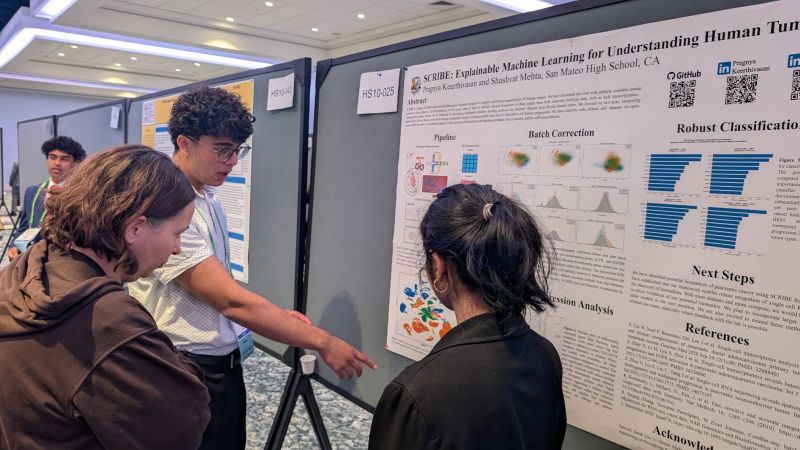
We presented SCRIBE as a research poster at the AACR Annual Meeting in San Diego in April 2026. The work was presented in poster format.


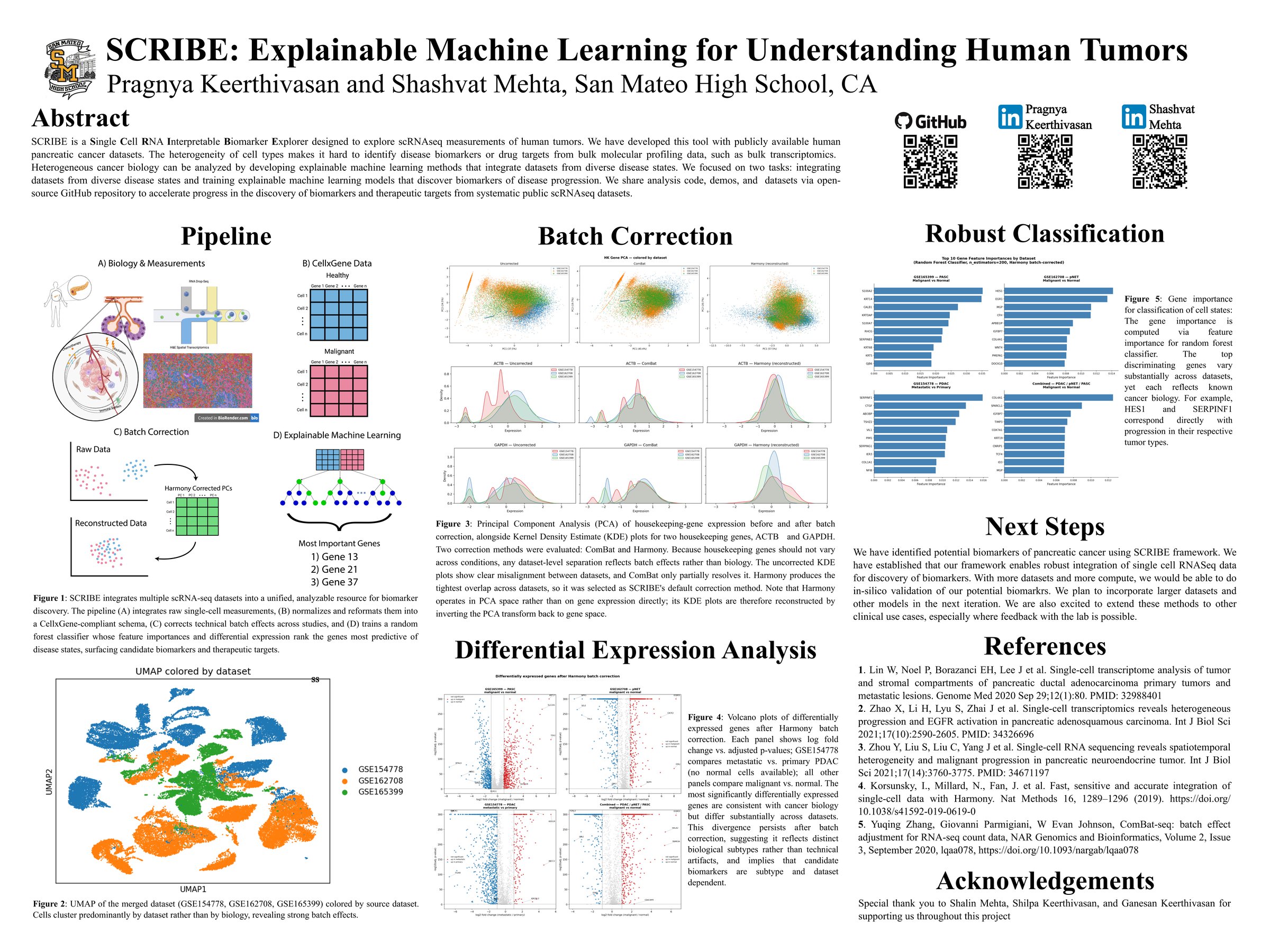
The poster is archived on Zenodo with DOI 10.5281/zenodo.21762528.